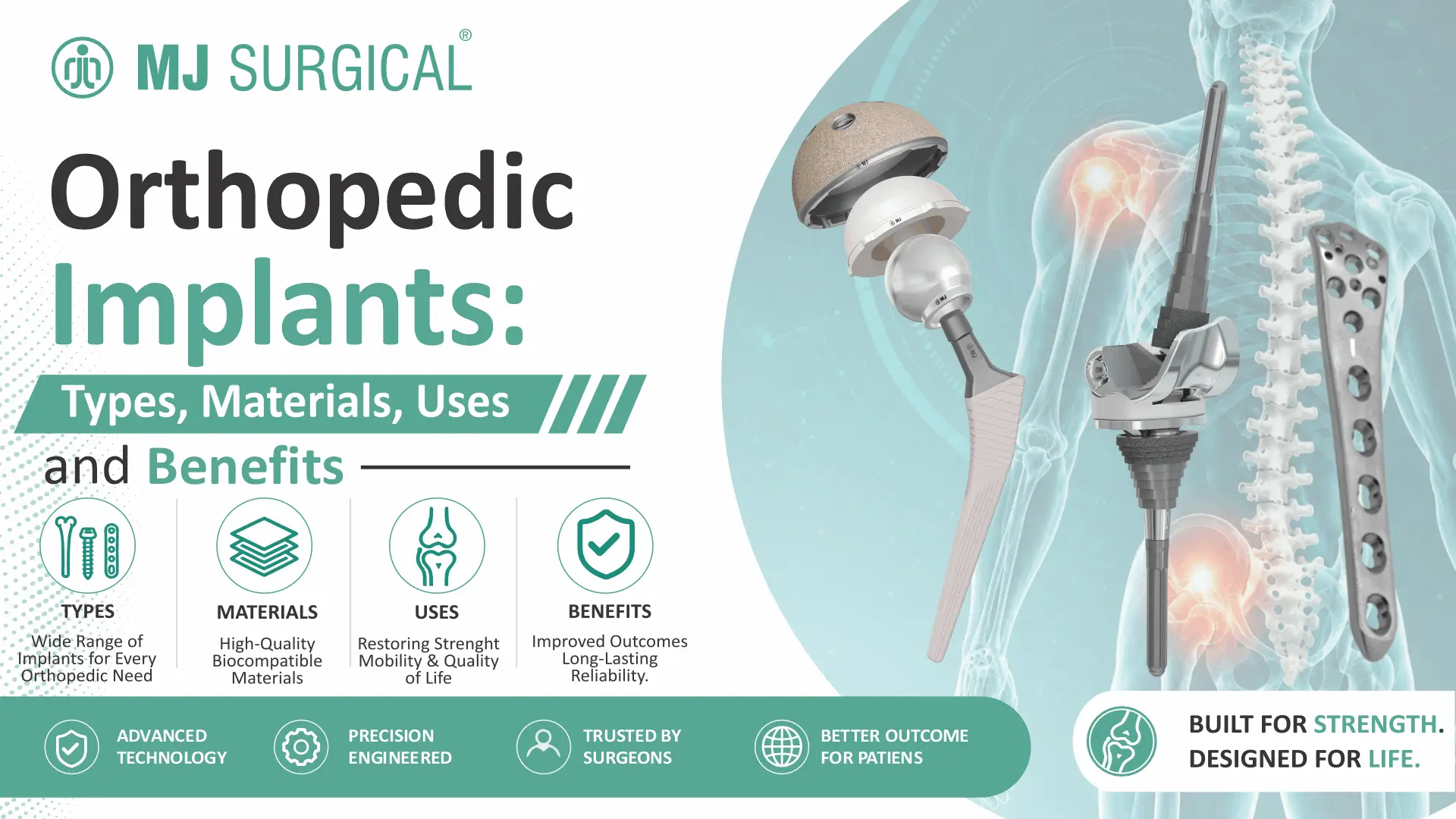
Orthopedic implants are medical devices used to support, stabilize, repair, or replace damaged bones and joints. Every year, surgeons around the world rely on them to treat fractures, restore worn-out joints, correct spinal conditions, and rebuild bone that has been lost to trauma or disease. What looks like a simple metal plate or screw on the outside is, in reality, the product of careful engineering — designed to bear load, resist corrosion inside the body, and work in harmony with living bone.
For hospitals, surgeons, and medical procurement teams, understanding how orthopedic implants are classified, what they are made of, and how the right system is chosen is more than academic interest — it directly affects surgical outcomes, patient recovery, and long-term implant performance. This guide walks through the essentials in plain language, from the different types of orthopedic implants to the materials behind them and what separates a reliable implant manufacturer from the rest.
What Are Orthopedic Implants?
At their core, orthopedic implants are devices placed inside or attached to the body to support the musculoskeletal system. Depending on the case, an implant may hold a fractured bone in the correct position while it heals, stabilize a damaged joint, replace a worn joint surface entirely, or provide the structural framework needed for bone reconstruction.
Orthopedic implants are used across nearly every major joint and bone in the body, including the:
- Hip
- Knee
- Shoulder
- Elbow
- Ankle
- Wrist
- Spine
- Long bones and other areas of the musculoskeletal system
There is no single implant that works for every patient. The right choice always comes down to the patient’s condition, anatomy, the nature of the surgery, and the treating surgeon’s clinical judgment.
Benefits of Orthopedic Implants
When used appropriately, orthopedic implants offer several clinical advantages that make modern fracture care and joint surgery possible:
- Faster, more predictable bone healing through stable fixation
- Restored joint mobility and reduced pain in patients with severe joint damage
- Correction of bone deformities and misalignment
- Support for early mobilization, which can reduce complications linked to prolonged bed rest
- A structural foundation for complex reconstructive and revision surgery
These benefits are only realized when the implant is correctly selected, properly manufactured, and skillfully placed — which is why implant quality and surgical technique go hand in hand.
Types of Orthopedic Implants
Orthopedic implants are generally classified by their purpose and the anatomical area they are designed for. Below are the major categories used in orthopedic practice today.
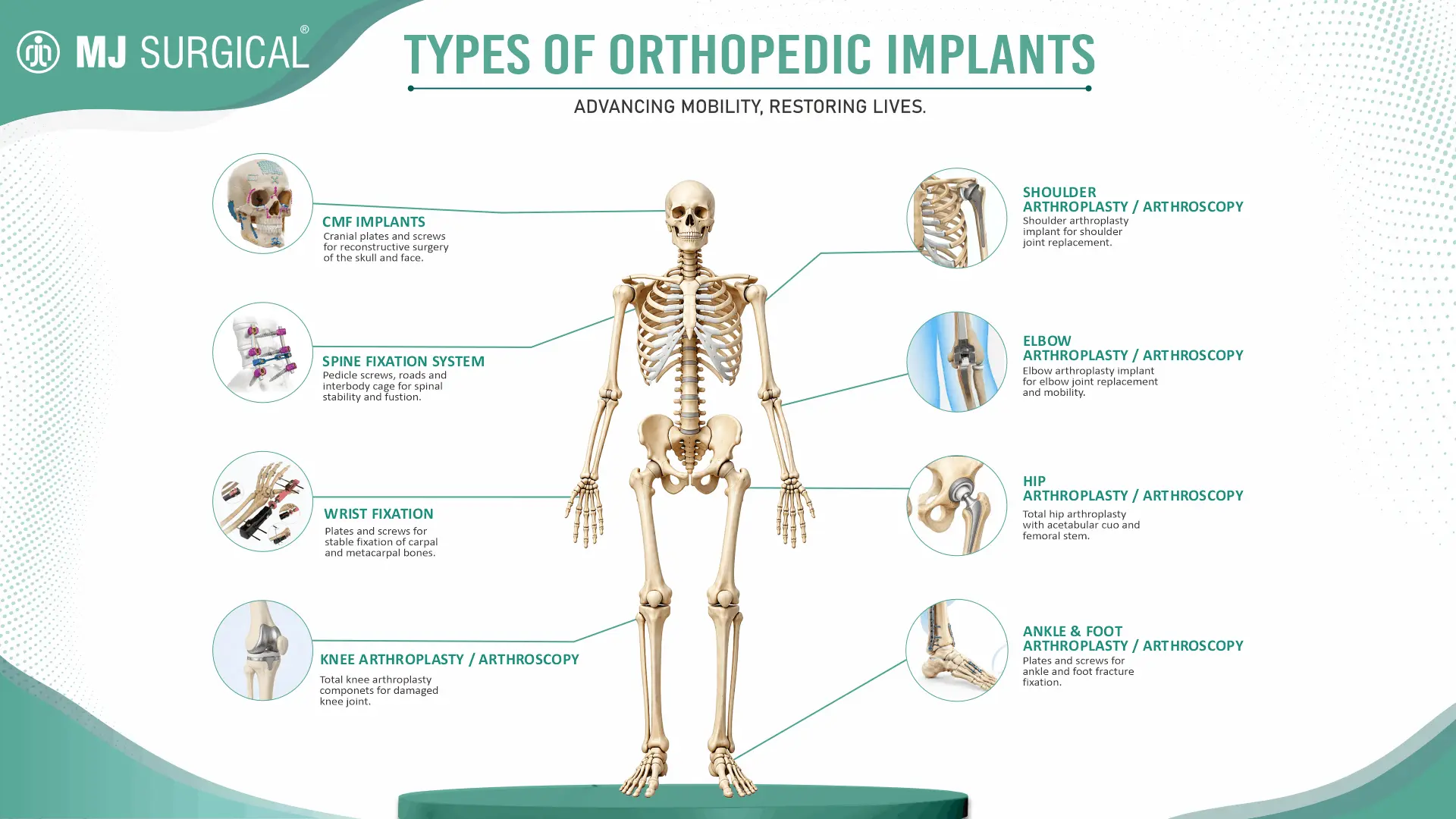
1. Trauma / Fracture Fixation Implants
Trauma implants are used to stabilize bones after fractures and other traumatic injuries. This category includes bone plates, locking plates, compression plates, orthopedic screws, intramedullary nails, pins, wires, and external fixation systems. Together, these devices hold bone fragments in alignment and provide the mechanical stability needed for natural healing to take place. Explore Trauma Implants →
2. Joint Replacement (Arthroplasty) Implants
Arthroplasty implants replace damaged portions of a joint with artificial components, restoring movement and relieving pain caused by conditions like osteoarthritis. Common applications include hip, knee, shoulder, elbow, and radial head replacement. A typical hip replacement system, for instance, may include a femoral stem, femoral head, and acetabular component working together to recreate natural joint mechanics. Explore Arthroplasty Implants →
3. Spine Implants
Spinal implants provide stability and alignment during spinal fusion and reconstructive procedures. This category includes pedicle screws, spinal rods, interbody cages, spinal plates, and cervical and thoracolumbar fixation systems, each designed for a specific segment and condition of the spine. Explore Spine Implants →
4. Arthroscopy Implants
Used during minimally invasive procedures performed with an arthroscope, these implants include suture anchors, interference screws, fixation buttons, and meniscal repair devices. They are commonly used to treat soft-tissue and ligament injuries in the knee, shoulder, hip, ankle, elbow, and wrist. Explore Arthroscopy Implants →
5. Limb Salvage & Revision Implants
These specialized systems are used in complex cases involving significant bone loss, failed joint replacements, tumor-related defects, or severe trauma. Examples include rotating-hinge revision knee systems and femoral or tibial replacement components designed to reconstruct rather than simply repair. Explore Limb Salvage & Revision Implants →
6. Cranial & Maxillofacial (CMF) Implants
CMF implants are used for the reconstruction and fixation of the skull, face, and jaw. This category includes cranial plates, facial plates, maxillofacial plates, and CMF screws, engineered specifically for the fine anatomical detail of the craniofacial region. Explore CMF Implants →
What Are Orthopedic Implants Made Of?
Material selection is one of the most critical decisions in orthopedic implant design. The chosen material must withstand mechanical load, resist corrosion inside the body, and remain biocompatible for as long as the implant stays in place. The most common orthopedic implant materials include:
- Titanium and titanium alloys — prized for a high strength-to-weight ratio, excellent corrosion resistance, and strong biocompatibility, making them a popular choice for fixation devices and spinal implants
- Stainless steel — offers dependable mechanical strength and rigidity at a lower cost, and has a long track record in fracture fixation devices
- Cobalt-chromium alloys — valued for hardness and wear resistance, frequently used in joint replacement components that face repeated loading
- Polyethylene (UHMWPE) and PEEK — used as bearing and structural materials, particularly in joint and spinal applications where imaging compatibility matters
- Ceramics — used in select bearing surfaces for their hardness and low-friction properties
A common question surgeons and buyers ask is whether titanium or stainless steel orthopedic implants are the better option. In truth, neither material is universally superior — titanium tends to be favored where weight, imaging compatibility, and corrosion resistance matter most, while stainless steel remains a reliable, cost-effective choice for many standard fixation applications. The right material always depends on the implant’s design, its intended surgical application, and the mechanical demands it will face.
How Do Orthopedic Implants Work?
The function of an implant depends entirely on its purpose. In fracture fixation, the implant holds bone fragments in position and shares the mechanical load while the body’s natural healing process rebuilds the bone. In joint replacement, the implant physically replaces damaged joint surfaces, creating a new, artificial articulation that allows pain-free movement. In spinal procedures, implants provide structural stability between or around vertebral segments, while in arthroscopy, small fixation devices anchor repaired soft tissue back to bone.
It’s worth remembering that an implant does not replace the body’s healing process — it supports it. The implant provides mechanical stability; the patient’s own biology does the rest.
How Are Orthopedic Implants Selected?
Choosing the right orthopedic implant is rarely a simple decision. Surgeons typically weigh factors such as the type and location of the injury, the patient’s bone quality and anatomy, age and activity level, required fixation strength, and whether the case is a primary or revision procedure.
For hospitals, distributors, and procurement teams, the decision extends further — implant specifications, material certifications, manufacturing quality, instrument compatibility, packaging, sterilization requirements, and regulatory compliance all factor into the final choice. A well-informed selection process reduces surgical risk and supports better long-term outcomes.
Orthopedic Implants vs. Orthopedic Instruments
It’s easy to confuse implants with instruments, but the two serve very different roles. An orthopedic implant is designed to remain in or on the body — used for fixation, reconstruction, replacement, or support. An orthopedic instrument, by contrast, is the surgical tool used to prepare the site, position the implant, and insert or adjust it. A bone plate, for example, is an implant, while the drill, screwdriver, or insertion guide used to place it is an instrument. Since implants and instruments must work together seamlessly during surgery, compatibility between the two systems is essential for a smooth, efficient procedure.
Orthopedic Implant Manufacturing and Quality Standards
The performance of an orthopedic implant depends on far more than the raw material it’s made from. Design accuracy, dimensional precision, surface finishing, cleaning, inspection, packaging, and quality control all play a role in whether an implant performs reliably inside the body. Reputable manufacturers rely on computer-aided design and manufacturing (CAD/CAM) processes, precision machining, and rigorous inspection protocols to maintain consistency across every batch produced.
Hospitals and healthcare buyers are well advised to evaluate implants based on their intended clinical application, technical specifications, and regulatory documentation — rather than price alone. In a category where implant failure can have serious consequences, manufacturing discipline is not optional; it’s the foundation of patient safety.
Why Choose MJ Surgical for Orthopedic Implants
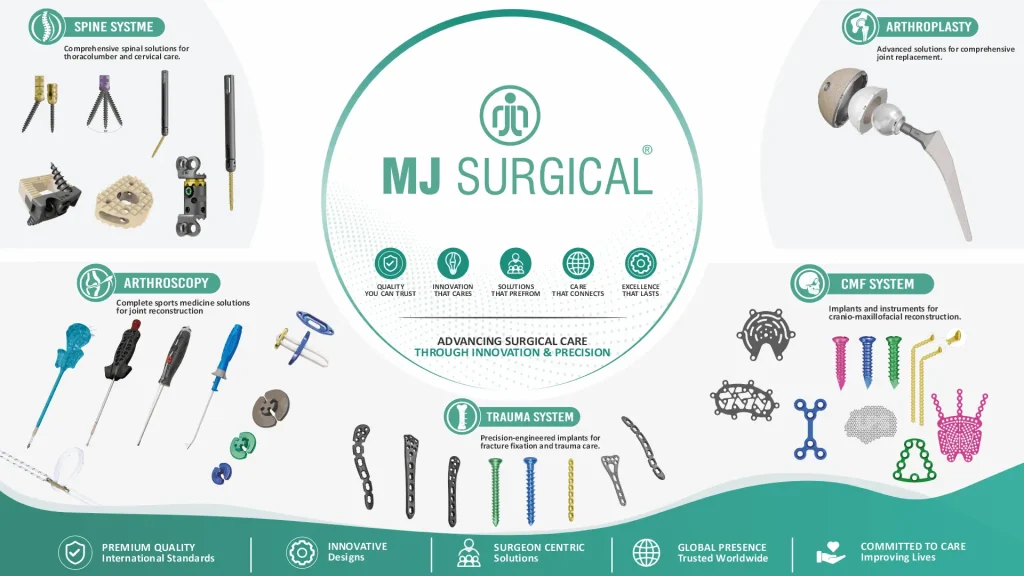
MJ Surgical is an Ahmedabad, India-based manufacturer, supplier, and exporter of orthopedic implants and instruments, with a product portfolio spanning Trauma, Spine, Arthroscopy, Arthroplasty, Limb Salvage & Revision, and Cranial & Maxillofacial applications. This makes MJ Surgical a single, reliable sourcing partner for hospitals, surgeons, and distributors across India and internationally.
Our implants are manufactured using stainless steel, titanium alloys, and PEEK, with materials tested for biocompatibility and safety in line with applicable standards. Our in-house R&D, production, and quality teams work together using CAD and CAM technologies — including PTC Creo and Mastercam — to ensure consistent, dependable manufacturing from design through delivery. In addition to our standard implant range, we offer OEM manufacturing and customized implant and instrument development for global partners looking for a manufacturing partner they can rely on.
Frequently Asked Questions About Orthopedic Implants
1. What are orthopedic implants?
Orthopedic implants are medical devices used to stabilize, repair, reconstruct, or replace damaged bones and joints during orthopedic treatment and surgery.
2. What are the main types of orthopedic implants?
The main types include trauma and fracture fixation implants, joint replacement (arthroplasty) implants, spine implants, arthroscopy implants, limb salvage and revision implants, and cranial and maxillofacial (CMF) implants.
3. What materials are orthopedic implants made of?
Common materials include titanium alloys, stainless steel, cobalt-chromium alloys, polyethylene (UHMWPE), PEEK, and ceramics. The right material depends on the implant’s design and intended clinical use.
4. Is titanium better than stainless steel for orthopedic implants?
Neither material is universally better. Titanium is often preferred for its strength-to-weight ratio and imaging compatibility, while stainless steel offers reliable strength at a lower cost. The right choice depends on the implant design and surgical requirement.
5. Are orthopedic implants permanent?
Not always. Some implants, particularly joint replacement components, are designed for long-term use, while certain fixation devices may be removed once healing is complete, depending on the patient’s condition and the surgeon’s recommendation.
6. Where can I source quality orthopedic implants in India?
MJ Surgical, based in Ahmedabad, Gujarat, manufactures and exports a full range of orthopedic implants and instruments for hospitals, surgeons, and distributors in India and abroad.
Conclusion
Orthopedic implants are at the heart of modern orthopedic care — from the plates and screws that stabilize a broken bone to the joint replacement systems that restore mobility after years of pain. Choosing the right implant is a decision shaped by the patient’s anatomy, the nature of the surgery, and, just as importantly, the quality and reliability of the manufacturer behind the product.
MJ Surgical offers a complete range of orthopedic implants and instruments across trauma, spine, arthroscopy, arthroplasty, limb salvage and revision, and cranial and maxillofacial applications — backed by disciplined manufacturing and quality processes. Explore our full range to find the right implant solution for your surgical needs.
Explore MJ Surgical’s Orthopedic Implants →
About the Author
MJ Surgical Clinical & Product Team.
This article was prepared by the MJ Surgical Clinical & Product Team, drawing on established medical and orthopedic education resources. The content is intended for educational and informational purposes.
References
This article draws on publicly available patient-education resources published by recognized medical authorities:
- 1. American Academy of Orthopaedic Surgeons (AAOS) — OrthoInfo: Total Joint Replacement — the peer-reviewed patient information portal of the leading U.S. professional association for orthopaedic surgeons.
- 2. U.S. Food and Drug Administration (FDA) — General Information about Hip Implants — the federal agency responsible for regulating the safety and effectiveness of medical devices in the United States.
Disclaimer
This information is for educational purposes only and not a substitute for professional medical advice. Always consult your doctor for medical concerns.